630-584-4800

-

- Home
- Our Firm
- Divorce
- The Illinois Divorce Process
- Grounds for Divorce
- Alimony / Maintenance
- Child Custody / Parental Responsibilities
- Parenting Time
- Child Support
- The Stay at Home Parent and Divorce
- Property Division
- High Asset Divorce
- Tax Implications of Divorce
- Divorce for Older Couples
- Uncontested Divorce
- High Conflict Divorce
- Change in Venue or Jurisdiction
- Subpoenas
- Annulments
- Post Divorce Modifications
- Post Divorce Enforcement and Contempt of Court
- Workers Compensation Claims and Personal Injury Claims in Divorce Cases
- Family Law
- Criminal Defense
- Blog
- Media
- Contact

My Spouse is Accusing Me of Child Abuse in Our Divorce to Get Custody. What Can I Do?
 As a parent, being accused of intentionally harming your child can be shocking and deeply offensive. Sadly, some parents will do whatever it takes to gain an advantage in divorce or child custody proceedings, even if it means fabricating allegations of child abuse. Psychiatric Times reports that anywhere from two to 35 percent of child custody cases involve allegations of abuse. This highlights a disturbing trend of people using false allegations of abuse as a tactic to secure more or sole custody.
At Goostree Law Group, our Wheaton, IL child custody attorneys can help you push back against a false narrative. Attorney Tricia Goostree has over 20 years of experience in family law, including experience in contested custody cases.
How Do Allegations of Abuse Affect Child Custody Rights?
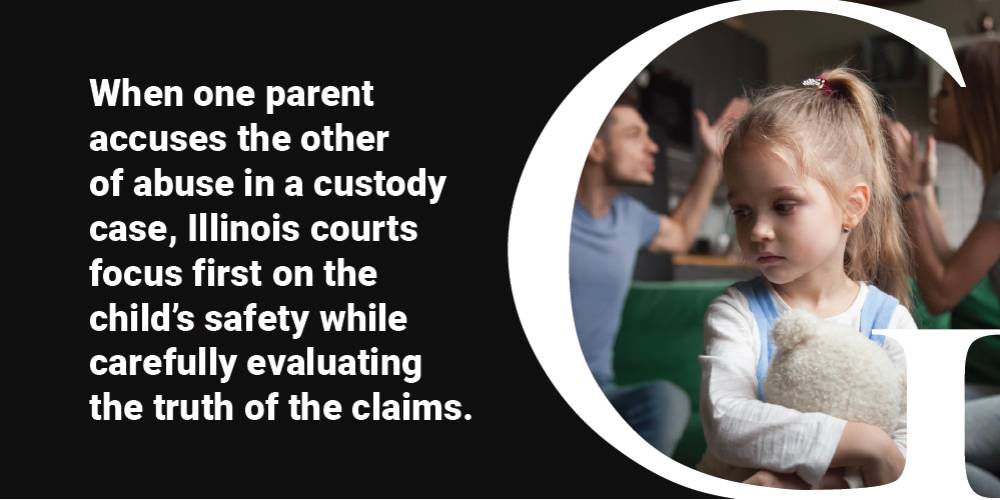
When one parent claims the other has abused a child, the court will look closely at the situation. In Illinois, judges always consider what is in the child’s best interests. This means the court focuses on the child’s safety, emotional health, and long-term stability, even when that is hard for the adults involved.
Under the Illinois Marriage and Dissolution of Marriage Act, judges must consider any past or present abuse when they divide parenting time and decision-making responsibilities. If the court believes a child is at real risk of harm, it can limit, supervise, or temporarily stop a parent’s parenting time. The court may also require supervised visits at a safe location.
Abuse allegations are taken extremely seriously. A parent who faces these accusations may be ordered to stay away from the child or follow strict limits until more information is gathered. These steps are meant to protect the child while the court determines the truth.
Illinois courts also understand that false accusations can be very damaging. If the judge finds that a parent knowingly lied about abuse to gain an advantage, that choice can hurt that parent’s own custody case. A parent who is willing to frighten a child or poison the child’s relationship with the other parent may not be acting in the child’s best interests. In serious cases, the court can change parenting time or decision-making to protect the child from further emotional harm.
Three Steps to Take if You Have Been Accused of Abuse in a Custody Dispute
If your ex is lying by saying you abused your child, you may be unsure of how to handle the situation. There is no perfect strategy, and each case is different. However, there are a few steps you should immediately take if you find yourself in this situation.
Comply With Orders of Protection
An emergency order of protection is often issued on the same day it is requested and may be based solely on the petitioner’s testimony. If your spouse got an order of protection against you, the order may require you to stay away from your spouse and children. It may even require you to move out of your own home.
Even if the grounds for the protection order are false, the best thing to do is to comply with the protection order for now. Getting arrested for violating the order will only complicate your case and make it harder for the truth to come out. Although it is extremely hard not to, it is crucial that you do not confront your spouse or try to see your children in violation of the order.
Work With an Attorney Experienced in Complex Child Custody Disputes
If you were falsely accused of abuse, you need a lawyer who knows what you are going through and how to handle it. Work with an attorney who has experience representing parents in child custody disputes. Your lawyer can help you determine the next steps. You may need to attend a hearing to tell your side of the story and defend yourself. Your lawyer can represent you and advocate for you and your children during this hearing.
Document All Interactions with Your Ex
Note-taking may seem inconsequential in a situation like this, but documenting your spouse’s behavior is one of the best things you can do to assist your lawyer. Keep track of the days on which you saw your children and the days they were with the other parent. Save emails, text messages, voicemails, and other forms of communication between you and your ex.
If your ex threatens you verbally or admits to making up the allegations, write down exactly what was said, who witnessed the statements, and the date, time, and location in which the conversation occurred. This information can be crucial to your case.
How Illinois Courts Handle Allegations of Abuse in 2026
Illinois courts rely on guardians ad litem, often called GALs, to help with contested custody cases. A GAL is a specially appointed attorney whose job is to represent the child’s best interests, not either parent. The GAL does not "take sides" in the usual way. Instead, they investigate what is really happening in the child’s life.
A GAL may interview both parents, the child, and other important people such as teachers, counselors, doctors, or caregivers. They often review school and medical records and prior court documents. The GAL might visit each parent’s home to see where the child would sleep and how the child behaves in each environment.
After the investigation, the GAL prepares a report for the judge. The report explains what the GAL learned and includes recommendations about parenting time, decision-making, and safety measures. The GAL may suggest supervised parenting time, counseling, or other safeguards if they believe abuse may have occurred or if the situation feels unsafe or confusing for the child. Judges are not required to follow the GAL’s recommendations, but they usually carry significant weight.
Contact a DuPage County, IL Family Law Attorney
If your spouse is trying to get custody of your children by making up stories of abuse, you need an attorney who can advocate on your behalf. Call 630-584-4800 to contact the skilled Wheaton, IL child custody lawyers at Goostree Law Group for help. We offer consultations.

Schedule a Consultation Today
Complete the contact form below or call us at 630-584-4800 today.
630-584-4800
555 S. Randall Road, Suite 200
St. Charles, IL 60174
Follow Us