630-584-4800

-

- Home
- Our Firm
- Divorce
- The Illinois Divorce Process
- Grounds for Divorce
- Alimony / Maintenance
- Child Custody / Parental Responsibilities
- Parenting Time
- Child Support
- The Stay at Home Parent and Divorce
- Property Division
- High Asset Divorce
- Tax Implications of Divorce
- Divorce for Older Couples
- Uncontested Divorce
- High Conflict Divorce
- Change in Venue or Jurisdiction
- Subpoenas
- Annulments
- Post Divorce Modifications
- Post Divorce Enforcement and Contempt of Court
- Workers Compensation Claims and Personal Injury Claims in Divorce Cases
- Family Law
- Criminal Defense
- Blog
- Media
- Contact

How Are Workers’ Compensation Benefits Treated in an Illinois Divorce?
 If you were injured at work, your workers’ compensation benefits may help you and your family stay financially stable. These payments can cover medical bills, lost wages, and therapy costs. What happens when a person who is receiving workers’ compensation benefits gets divorced?
Illinois law has guidelines to help decide whether your workers’ compensation payments count as marital property. It also determines how they might affect child support or alimony. If you are in this situation, a St. Charles, IL divorce lawyer can help protect your rights and explain how the law applies to your case.
Are Workers’ Compensation Benefits a Marital Asset in Illinois?
In Illinois, most assets that you or your spouse acquire during the marriage are considered marital property. That means both of you have a legal interest in them. The Illinois Marriage and Dissolution of Marriage Act, in 750 ILCS 5/503, explains how marital property is defined and divided during divorce.
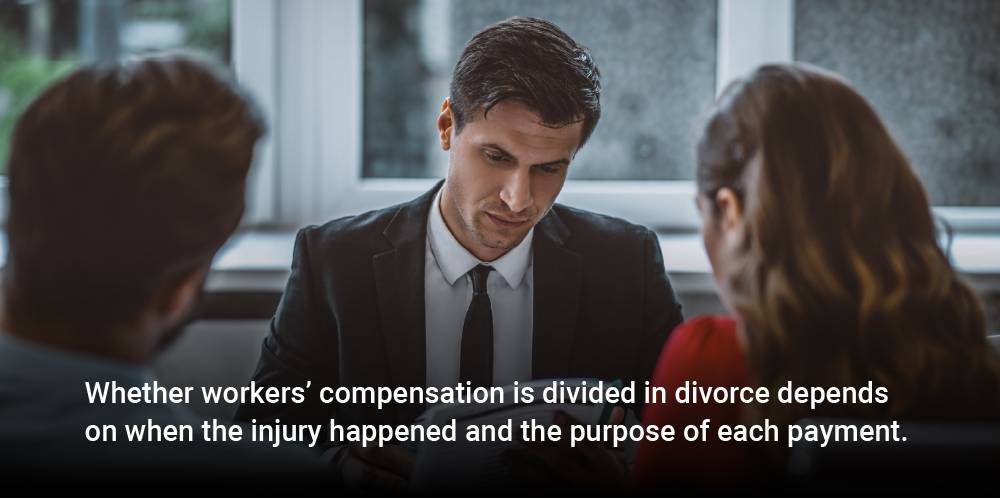
Workers’ compensation benefits are sometimes part of the marital estate, depending on when the injury happened. If your workplace injury occurred during the marriage, your benefits may be seen as marital property. That means the money could be divided between you and your spouse.
If you were injured before you got married or after a court-approved legal separation, the benefits are usually considered your non-marital property. Non-marital property belongs only to one person and is not divided in a divorce.
Things can get confusing if you were hurt while married but received the settlement later. Courts look at what the benefits are meant to replace. If the payments cover wages lost during the marriage, they are often treated as marital property. If they replace income that you would earn after the divorce, they are usually non-marital.
Judges also look at how the payments are made. A lump-sum settlement is a one-time payment. Installment benefits are smaller amounts paid over time. Each case is different, so the court studies the details before deciding if your spouse is entitled to part of your benefits.
How Does Illinois Divide Workers’ Compensation in a Divorce?
Illinois is an equitable distribution state. When the court divides property, it does so fairly but not necessarily equally. The court tries to find a balance that makes sense for both spouses. When dividing workers’ compensation benefits, judges look at several factors, including:
-
The date and cause of the injury
-
How long the benefits will continue
-
The financial situation of each spouse
-
Whether one spouse has already received valuable assets
-
Whether a prenuptial agreement exists
If your benefits come as a lump-sum payment, the court can decide what marital share, if any, your spouse receives. If your payments come monthly, the judge may divide them over time.
Your attorney can help by showing how your injury has affected your ability to work and by explaining how your benefits are being used. Keeping complete records, such as medical bills, claim forms, and payment letters, helps the court understand your financial situation.
Can Workers’ Compensation Affect Child Support or Alimony?
Even if your benefits are not divided as marital property, they can still affect child support or spousal maintenance, commonly known as alimony. That is because these benefits are considered income when the court calculates support.
Under 750 ILCS 5/505, Illinois courts use both parents’ income to determine child support. Workers’ compensation payments are counted as income in this calculation. The same applies to spousal maintenance under 750 ILCS 5/504. This law says that income, including workers’ compensation, can affect how much support is paid or received. If you pay child support, the court may take a portion directly from your benefit checks. If you receive support, your spouse’s benefits could increase the amount you receive.
If your payments change, such as moving from monthly checks to a lump-sum settlement, you can ask the court to review the order. This helps keep your support obligations fair and up to date. Not reporting major income changes can cause serious legal problems.
How Are Future or Permanent Disability Benefits Handled?
Some injuries cause permanent disability, which means you may never return to your previous level of work. These cases often involve long-term payments. Courts treat these payments differently from temporary benefits.
If your benefits replace income that you would have earned after the marriage ended, they are usually non-marital property. However, if they cover wages you lost while you were married, that portion is often treated as marital property. Many settlements combine both types of compensation. In that situation, the court may ask a financial expert to calculate what share belongs to each time period.
How Can You Protect Your Workers’ Compensation During Divorce?
If you are receiving or expect to receive workers’ compensation, there are steps you can take to protect your rights and stay organized:
-
Keep detailed records: Save copies of your claim forms, payment statements, and medical reports. These documents show when your injury occurred and how much you received.
-
Review your settlement carefully: Make sure the agreement separates compensation for past lost wages from money for future income. This can help protect your non-marital property.
-
Understand tax and support rules: Under 26 U.S.C. §104(a)(1), workers’ compensation benefits are not taxable. However, they still count as income for child support or maintenance calculations.
-
Be open about your income: Full honesty with the court helps you avoid disputes or penalties later.
-
Hire an experienced attorney: An experienced family law attorney who understands workers’ compensation law will make sure your benefits are fairly handled.
Contact a Kane County, IL Family Law Attorney
At Goostree Law Group, our attorneys have decades of combined experience helping families through complex divorces. Attorney Tricia Goostree leads the firm with skill, compassion, and dedication. She serves on the Prairie State Legal Services Board of Directors, volunteers with the Northern Illinois Food Bank, and offers pro bono legal services to families in need. She also helps coordinate the high school mock trial program for the Kane County Bar Association and Foundation.
When you work with us, you will receive practical advice and strong advocacy. To learn more, call 630-584-4800 today and schedule a free consultation with a knowledgeable St. Charles, IL divorce lawyer.

Schedule a Consultation Today
Complete the contact form below or call us at 630-584-4800 today.
Free Consultations
630-584-4800
555 S. Randall Road, Suite 200
St. Charles, IL 60174
Follow Us